EU Customs Reform 2026: End of the €150 Duty-Free Rule Explained
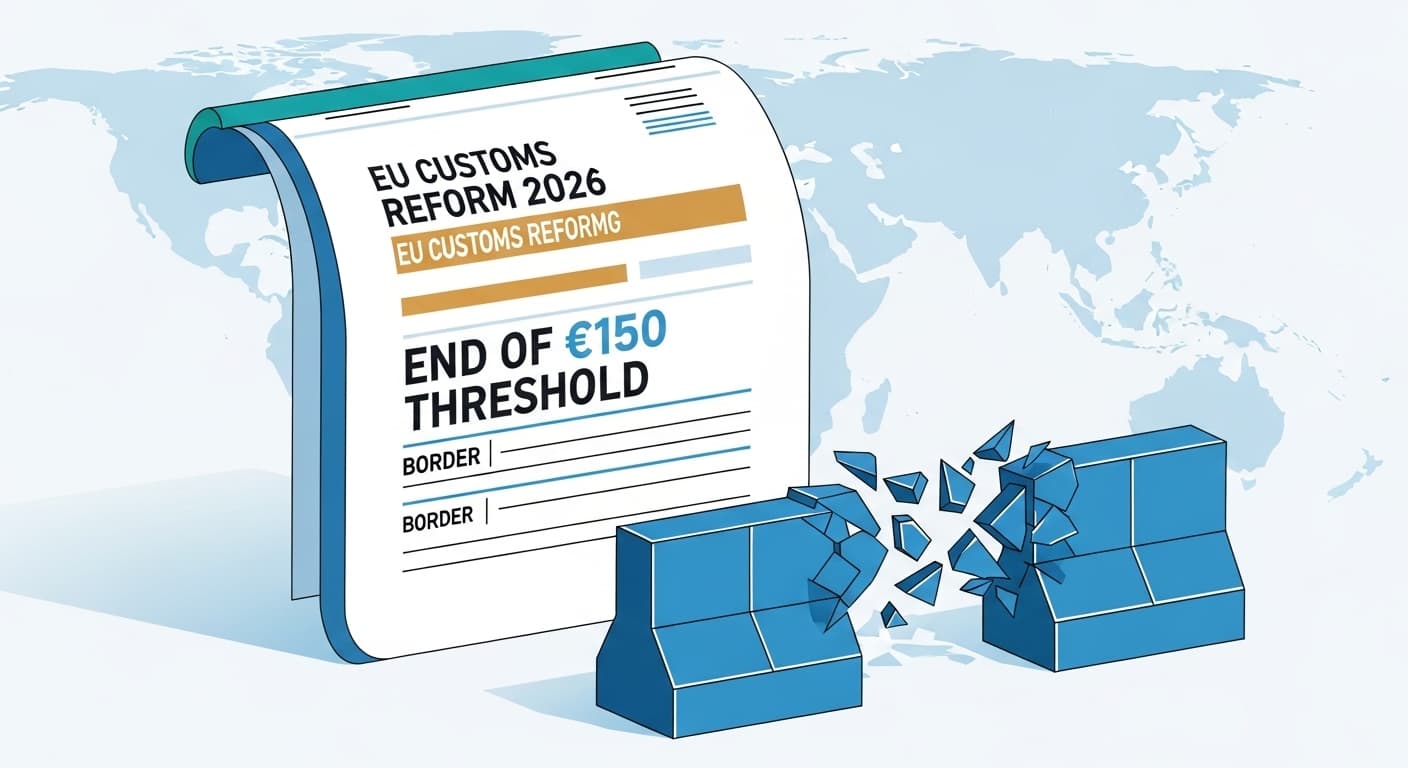
EU Customs Reform 2026: End of the €150 Duty-Free Rule Explained
The European Union is introducing one of the most significant changes to e-commerce customs regulations in recent years. Starting from July 1, 2026, the long-standing €150 duty-free threshold for imported goods will be removed.
This reform marks a major shift in how cross-border e-commerce shipments are taxed, processed, and regulated.
What is changing?
Until now, goods valued at €150 or less could enter the EU without being subject to customs duties. While VAT still applied, this exemption made low-value cross-border e-commerce highly efficient and cost-effective.
From July 2026, this exemption will no longer exist. All goods, regardless of value, may be subject to customs duties.
Introduction of a temporary flat duty (2026–2028)
To ease the transition, the EU plans to introduce a temporary flat duty of approximately €3 per item for low-value shipments between 2026 and 2028.
This is designed as an interim measure before more advanced customs systems are fully implemented.
Shift from parcel-level to product-level taxation
One of the most important changes is how duties are calculated. Instead of applying charges per shipment, customs authorities will increasingly calculate duties per product, based on individual HS codes.
This means that multi-item shipments will accumulate duties for each line item, potentially increasing total import costs.
What is the EU Customs Data Hub?
By 2028, the EU plans to introduce a centralized system known as the Customs Data Hub. This system will enable real-time data exchange and enforce full tariff application at the product (SKU) level.
Businesses will need to provide accurate and detailed data for every item they ship, including classification, origin, and value.
Why is the EU making this change?
The reform aims to address several challenges:
- Prevent undervaluation of imported goods
- Create fair competition for EU-based businesses
- Improve tax collection efficiency
- Enhance customs control through better data
Impact on e-commerce businesses
This reform will significantly affect how e-commerce companies operate:
- Low-value shipments will no longer be duty-free
- Costs may increase due to per-item duty calculations
- Customs compliance requirements will become more complex
- Customer experience may be impacted if costs are not handled properly
How businesses should prepare
To adapt to these changes, businesses should start preparing early:
- Shift to DDP (Delivered Duty Paid) to avoid unexpected customer charges
- Ensure accurate HS codes for all products
- Validate product origin and declared value
- Consider EU-based warehousing to optimize costs
- Encourage order consolidation to reduce per-item duty impact
Early signals from EU markets
Some EU countries, including France and Italy, are already experimenting with additional handling fees for low-value shipments. These developments indicate the direction of future enforcement across the EU.
Conclusion
The removal of the €150 duty-free threshold marks a fundamental shift in EU customs policy. For e-commerce businesses, this means moving from a simplified low-value import model to a more detailed, data-driven compliance approach.
By preparing early and adapting operational strategies, businesses can reduce risks, manage costs, and continue to provide a smooth customer experience in the evolving EU trade landscape.
👉 New to EU customs? Start with our beginner guide.