INCOTERMS® — Stop Memorizing Them. Understand the Journey.
INCOTERMS® — Stop Memorizing Them. Understand the Journey.
If you work in logistics, supply chain, procurement, import or export, you have probably come across terms such as EXW, FCA, FAS, FOB, CFR, CIF, DAP, DPU and DDP.
With so many Incoterms® to remember, it can be tempting to memorize what each abbreviation means. But there is a much easier way to understand them.
Ask three simple questions:
1. Who pays?
Who is responsible for the costs associated with moving the goods?
2. Who arranges?
Who organizes the transport, export formalities, import clearance and other required arrangements?
3. Who takes the risk?
At what point does the risk of loss or damage move from the seller to the buyer?
Once you understand these three questions, Incoterms® become much easier to follow.
EXW — Ex Works
Under EXW, the seller makes the goods available at their premises or another named place. The buyer takes on most of the responsibility from that point onward, including arranging transportation and export-related processes where applicable.
Memory trick: EXW → Buyer handles almost everything.
FCA — Free Carrier
Under FCA, the seller delivers the goods to the carrier or another party nominated by the buyer at the agreed place. The seller is responsible for the required export formalities.
Memory trick: FCA → Seller delivers to the carrier.
FAS — Free Alongside Ship
FAS is used for sea or inland waterway transport. The seller delivers the goods alongside the vessel at the named port of shipment.
Memory trick: FAS → Goods are placed alongside the vessel.
FOB — Free On Board
FOB is also used for sea or inland waterway transport. The seller delivers the goods on board the vessel at the agreed port of shipment.
Memory trick: FOB → Seller loads the goods on board.
CFR — Cost and Freight
Under CFR, the seller pays the cost and freight necessary to bring the goods to the named destination port. However, the risk transfers to the buyer once the goods are loaded on board the vessel at the port of shipment.
Memory trick: CFR → Seller pays freight, but risk transfers at origin.
CIF — Cost, Insurance and Freight
CIF works similarly to CFR, but the seller also arranges insurance cover for the goods during the journey to the named destination port, subject to the insurance requirements of the rule.
Memory trick: CIF → CFR + insurance.
DAP — Delivered at Place
Under DAP, the seller arranges transportation and delivers the goods to the agreed destination, ready for unloading. The buyer is generally responsible for import clearance and associated import duties and taxes.
Memory trick: DAP → Seller delivers; buyer handles import clearance.
DPU — Delivered at Place Unloaded
DPU goes one step further than DAP. The seller is responsible for delivering and unloading the goods at the named destination.
Memory trick: DPU → Seller delivers and unloads.
DDP — Delivered Duty Paid
DDP places the greatest level of responsibility on the seller. The seller arranges delivery to the agreed destination and handles export, transit and import formalities, including applicable import duties and taxes, subject to the terms and local requirements.
Memory trick: DDP → Seller handles almost everything.
The most important lesson: Cost is not the same as risk
This is where Incoterms® are often misunderstood.
Who pays does not always mean who takes the risk.
CIF is a classic example. The seller pays for the ocean freight and arranges insurance to the named destination port, but the risk transfers to the buyer when the goods are loaded on board the vessel at the port of shipment.
So when comparing Incoterms®, always separate these three questions:
- Who pays? — Cost responsibility
- Who arranges? — Operational responsibility
- Who takes the risk? — Risk transfer point
A simple way to remember the journey
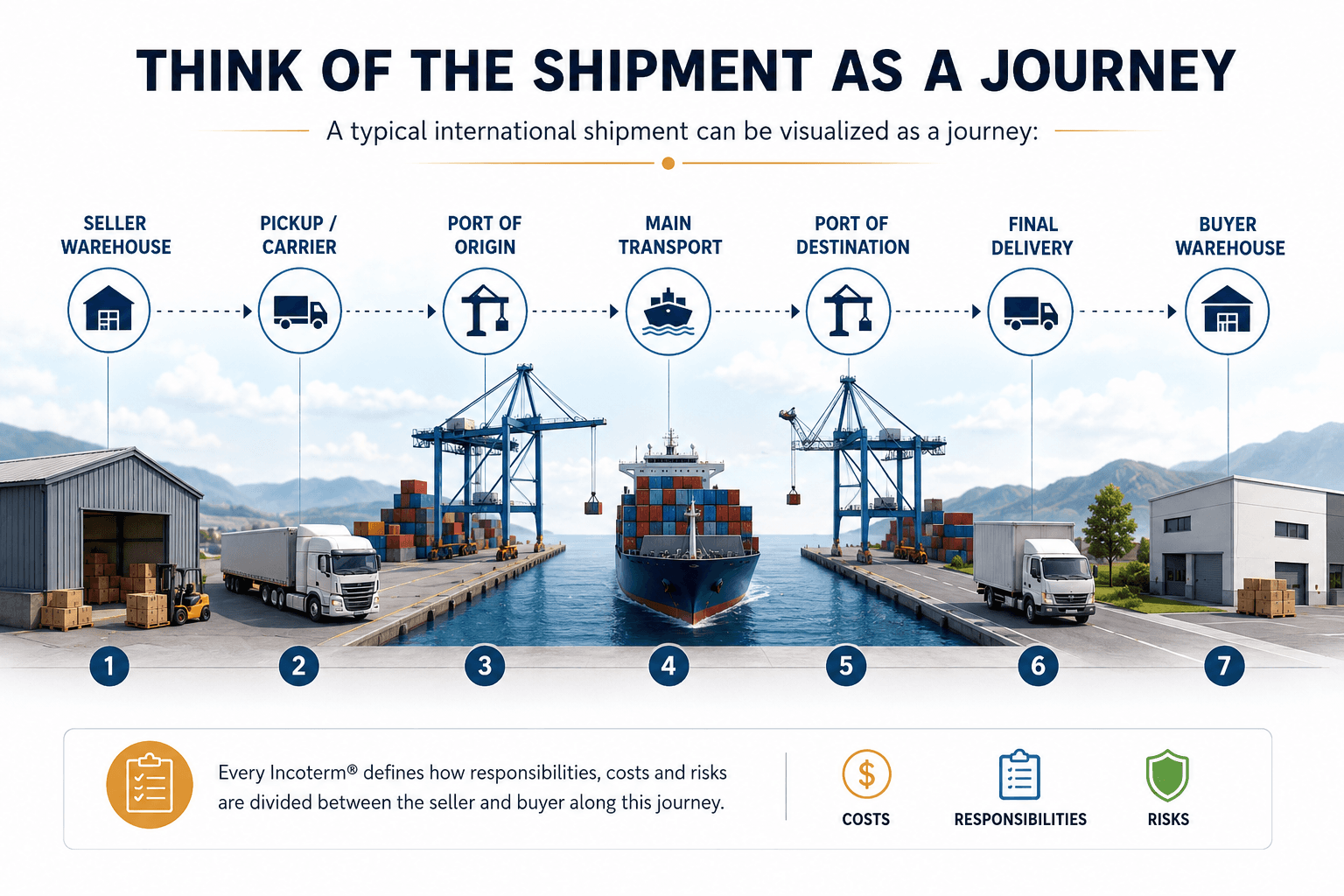
Instead of trying to memorize nine abbreviations independently, picture the physical movement of the shipment.
EXW starts with the buyer taking responsibility from the seller's premises.
FCA moves responsibility to the point where the seller delivers to the carrier.
FAS takes the goods alongside the vessel.
FOB puts the goods on board the vessel.
CFR/CIF have the seller paying the main freight, while risk transfers earlier at origin.
DAP/DPU move seller responsibility much closer to the destination.
DDP puts the greatest overall delivery responsibility on the seller.
Why this matters in real-world trade
Choosing the right Incoterm® affects quotations, purchase orders, freight costs, insurance, customs responsibilities and the point at which risk transfers between the parties.
A misunderstanding can lead to unexpected freight charges, unclear insurance responsibilities, customs delays or disputes over who was responsible when goods were damaged.
That is why Incoterms® should not simply be treated as abbreviations to memorize. They should be understood as a framework for dividing responsibilities throughout the shipment journey.
Conclusion
The next time you see EXW, FOB, CIF, DAP or DDP, don't start by asking what the abbreviation stands for.
Start with three questions:
Who pays?
Who arranges?
Who takes the risk?
Once you understand those three points, the Incoterm® becomes much easier to interpret.
If this helped you understand Incoterms® more easily, share it with someone working in logistics or supply chain.
👉 New to international trade? Explore our other customs and logistics guides to build your foundation step by step.